
Reach candidates and clients on the first try.
Recruiters call two very different people: candidates who aren't looking for a call and hiring managers who are busy. Check every number first, so your calls go to the right person's live phone.
- Recruiters and headhunters
- Recruitment business development
- Talent sourcers
- Agency owners
Different people, different calls.
Passive candidates
People who aren't job hunting. The call has to reach their own phone, not a switchboard at their current employer.
Hiring managers and clients
Business development calls to people with full calendars, where a wrong number wastes a rare window.
Placed candidates and references
Numbers collected months or years ago, often from CVs, that may no longer reach the person.
Why it's harder here.
A recruiter's calling list is personal by nature: one specific person at one specific number. A wrong number isn't just a wasted dial; it can mean calling a candidate's employer, or a stranger.
Recruitment databases age. Candidates change phones between roles, and numbers stored in an ATS years ago are rarely checked again before they're called.
Where the lists come from
- CV databases and job board applications
- Your ATS and CRM, built up over years
- Data tools like Apollo, Lusha and Cognism
- LinkedIn research
Where checking fits.
Between the shortlist and the first call. The name match signal matters most here: it checks the number belongs to the candidate, not to whoever has that number now.
- 1
Build a shortlist
From your ATS, a CV search or a data tool.
- 2
Check the numbers
Upload the shortlist as a CSV, or check from your AI tool.
- 3
Call the right numbers
High chance and Low chance by phone; Bad data by email and LinkedIn.
- 4
Update the record
Write the outcome back to your ATS so the next search starts cleaner.
How teams use it.
Headhunting passive candidates
Make sure the first approach reaches the candidate's own phone.
Reactivating an old database
Check years-old ATS records before a re-engagement campaign.
Business development
Check hiring manager numbers before a client calling block.
Working in recruitment: what's different.
Discretion matters
Reaching a candidate at their current employer's main line is a problem. A personal mobile with a name match is the call you want.
Databases are the asset
Checking an old database tells you which records are still reachable by phone and which need another channel.
A recruiting list, after checking.
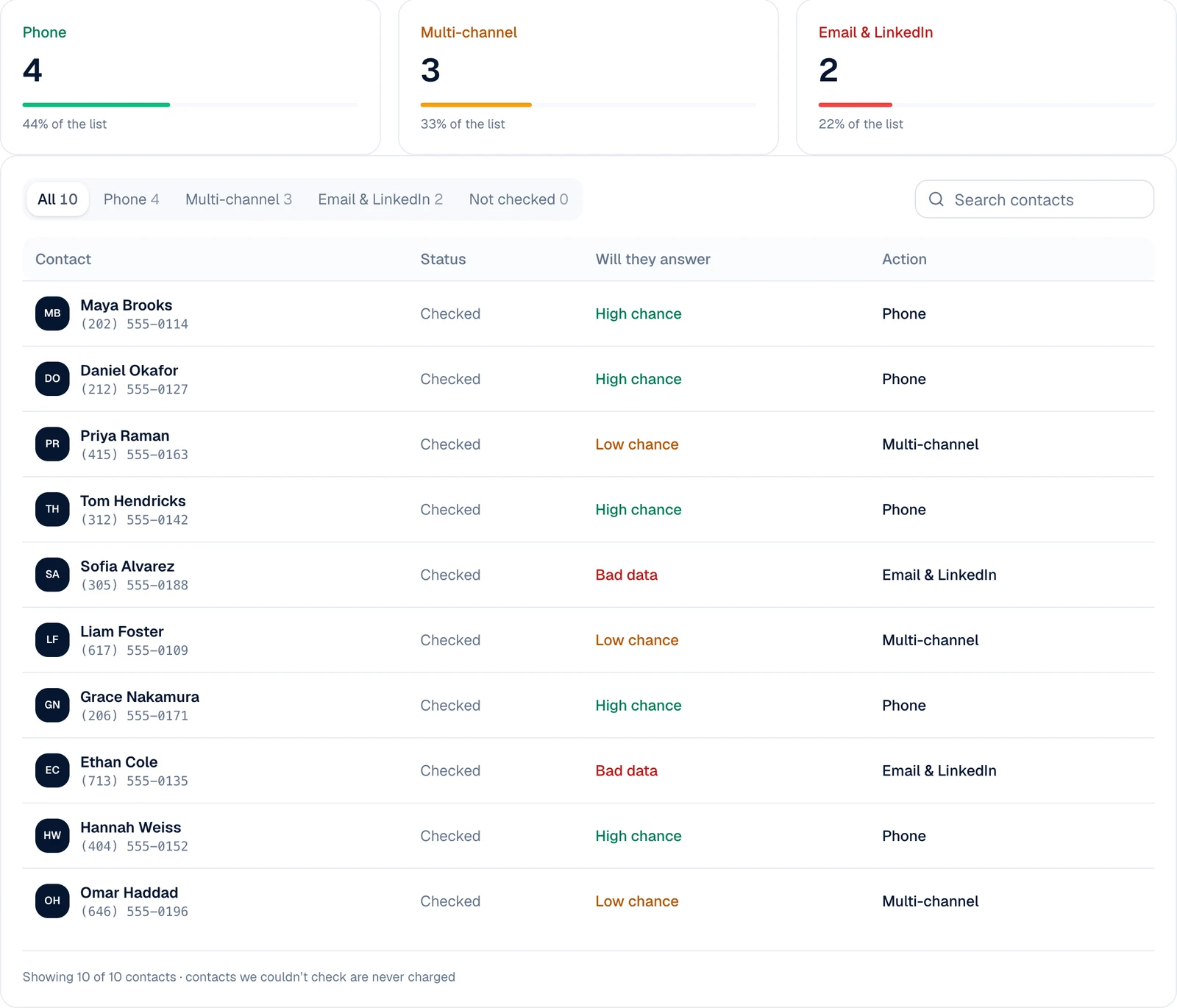
Questions, answered.
Can I check numbers from my ATS?
Yes. Export the records as a CSV with names and US phone numbers and upload it, or send them to the API.
Does it work for candidates outside the US?
No. US phone numbers only. Other numbers are skipped and not charged.
What if a candidate's number belongs to someone else now?
Name match catches that. A number that doesn't match the candidate can't come back High chance, so you know before you call a stranger by the candidate's name.
Related pages.
Know who’ll answer
before you call.
Grade 250 contacts free. No card required, and US phone numbers only.
- US phone numbers only
- No card required
- One credit per checked contact